
The Athens sewage system is one of the most important infrastructure projects in the Greek capital, with a history dating back to antiquity. Today, it is a modern and complex network that serves over 3.7 million residents of the wider area, ensuring the treatment of wastewater and the protection of public health.
The first known sewage infrastructures were constructed in the 5th century BC, with the “Great Sewer” draining water from the Acropolis and the agora.
After liberation, in the 19th century, Athens did not have an organized sewage system, resulting in epidemics such as cholera in 1854. The construction of a modern system began in the 1930s, but was essentially completed after 1990, with the creation of the National Sewerage Network and the Sewage Treatment Plant (STP) of Psyttalia.
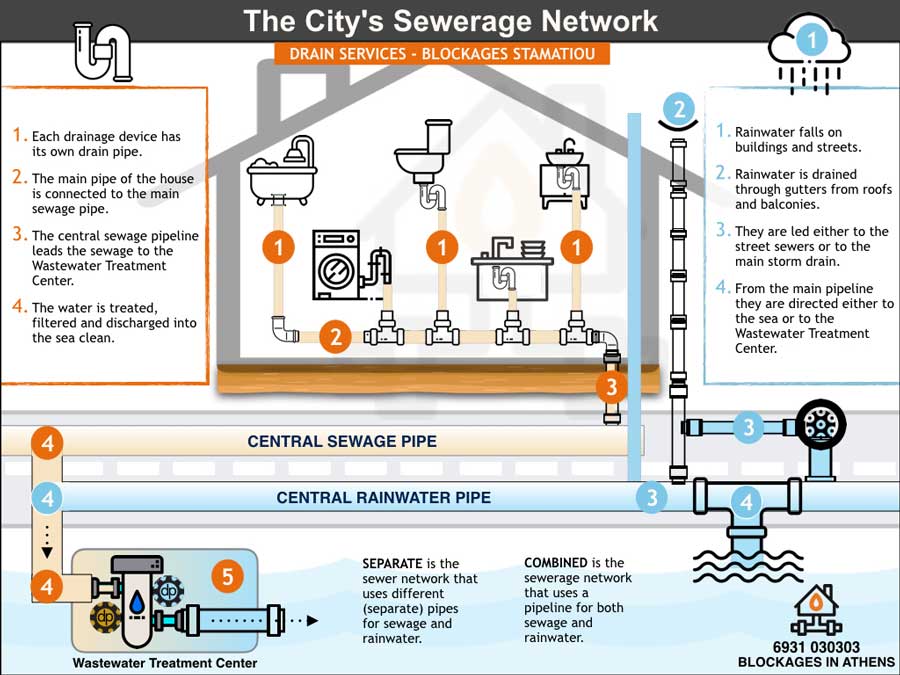
The modern sewage system of Athens
The current network includes thousands of kilometers of pipes (domestic and central) while the Psyttalia Wastewater Treatment Plant , one of the largest in Europe, with a capacity of 1,000,000 m³ of wastewater which it receives daily. There are 44 pumping stations at critical points in the Attica basin and emergency tanks to deal with floods.
EYDAP is responsible for the construction, operation and maintenance of the sewage network in its area of responsibility, as defined by article 8 of Law 2744/99.
A sewerage network means:
- the sewage pipes
- the pantorreic pipes (old mixed network in the center of Athens)
- the pumping stations, the depression pipes, the overflows
- any project that aims to collect and transport wastewater to the final recipients.
The most basic of the primary waste collectors are:
- The Central Sewerage Pipeline (CSP)
- The Supplementary Central Sewerage Pipeline (SCSP)
- The Parakiphisian Waste Collector
- The Central Coastal Collector
Wastewater pipes are usually gravity pipes, but where necessary, there are pipes that operate under pressure (depression). The drainage system of the Basin includes 44 pumping stations, mainly along the coastal front of Piraeus and the Saronic coast. The wastewater, through the main collectors, ends up in the Wastewater Treatment Plants.
Problems and modernization
Despite improvements, the sewage system in Athens faces various problems such as: precipitation, illegal connections that burden the network, and climate change, which increases the risk of flooding. Further modernization is expected , with an emphasis on sustainability and water recycling. The sewage system of Athens is a key point for urban development and the quality of life of its residents.
Historical development
- During the ancient period there were fragmentary conduits (e.g. Roman times), but without an organized network.
- The first pantorrheanic network was constructed in 1840 on Stadiou Street.
- By 1893 , the total length was only 11.5 km.
- In 1930-1959 , critical pipelines were completed (Central Sewer Pipe, Parakifis Collector).
- In 1980, EYDAP was founded and unified the management of water supply and sewage in Athens.
Structure and function
95% of today’s sewage network is a separate system (separate sewage and rainwater pipes) while 5% is pantorreic (mainly in the historic center).
Main pipelines
- Central Sewerage Pipeline (CSP) : 17 km, transports wastewater from the center to Psyttalia.
- Parakifisios Collector (PSA) : 34.5 km, covers northern areas.
Wastewater treatment
- Psyttalia WWTP (since 1994): Treats 90% of the basin’s wastewater, with decontamination >93%.
- Treated wastewater is discharged into the Saronic Gulf through underwater pipelines.

What is worsening the sewage network in Athens?
- Blockages caused by grease, garbage or root invasions (especially in areas with dense vegetation such as Kifissia).
- Oils, chemicals and plastics cause damage to the network and the KELs.
- In the center of Athens, pipes over 100 years old require frequent repairs using no-dig techniques.
Dealing with cutting-edge technologies
Digital monitoring using GIS for mapping 80% of the network and a SCADA system for automatic control of pumping stations.
- Preventive maintenance and CCTV inspections are carried out for early detection of cracks.
- Hydrodynamic cleaning with a high-pressure water jet mechanism to prevent blockages.
Citizens’ responsibility
- Homeowners are responsible for the pipes up to the connection to the public network.
- In old apartment buildings, professional clogging is often required due to small diameter pipes.
The system faces constant population pressure and urban sprawl, but with preventive maintenance and technological upgrades, its sustainable operation is ensured.
The sewage system in ancient Athens
The sewage system in ancient Athens reflected the technological advancement of the time, but also the social constraints that affected hygiene. Below is a detailed description based on archaeological and historical data:

Basic characteristics and historical development
- Early period. During the 5th century BC (the golden age), Athens developed a stone-built central sewer with a diameter of 1 meter, constructed with stone slabs at the base and covered with a covering. This removed waste from the central agora and densely populated areas to the outskirts of the city.
- Lack of an organized network. The system did not cover the city evenly. In many neighborhoods, sewage flowed into streams or collected in cesspools, causing epidemics (e.g. cholera) due to water contamination.
- Connection with urban planning. The implementation of the Hippodamian system (organized road network) facilitated the creation of sewers, especially around the Agora and the main roads.
Healthy infrastructure and daily practices
- Public toilets. They were used mainly by the elite and were located in public places (e.g. gymnasiums, marketplaces). They had marble or limestone slabs with holes, seating in rows, and running water from underground pipes to transport waste.
- Private facilities : In wealthy homes there were toilets with wooden or stone basins, connected to simple pipes leading to cesspools. However, there was no universal domestic sewage system.
- Cleaning methods :
- Pebbles or ceramic fragments (not paper) were used for cleaning.
- Wastewater from baths and public fountains flowed into streams, indirectly enhancing the cleaning of the streets.
3. Limitations and environmental impacts
- Cultural habits : Defecating in public was considered common , even in semi-open spaces. Only the elite had access to structured toilets.
- Pollution and diseases : The lack of systematic sewage removal led to:
- Contamination of water sources and soil.
- Epidemics (e.g. plague in the 4th century BC), especially during times of war or population growth.
- Lack of treatment : Waste was not cleaned before being dumped. It ended up in streams, torrents, or open areas outside the city.
Comparison with other ancient civilizations
- Minoan Crete (3,000 BC) : Athens lags behind the sophisticated systems of Knossos , where there were underground clay pipes, cisterns with water jets, and separate networks for rainwater and sewage.
- Roman Empire : The Romans adopted technologies from ancient Macedonia (e.g. underfloor heating), creating complex networks with hydraulic valves – something non-existent in Athens.

The sewage system of ancient Athens was
inconsistent and poorly organized , reflecting the city-state as
a social entity with an emphasis on public life rather than technological innovation. Despite the creation of central sewers during the Classical period, the lack of systematic infrastructure and the reliance on natural water flows limited its effectiveness. This differentiates Athens from civilizations such as the Minoan or Roman, where sanitation was a priority of urban planning.